
Strategic Guide to Selecting the Most Effective AI Music Tools for 2026 Production

The digital music revolution has reached a point where the distinction between professional studio output and AI-assisted composition is nearly invisible to the average listener. For the modern creator, the challenge is no longer about finding a tool that works, but about selecting a AI Music Generator that aligns with their specific aesthetic and functional requirements. As we navigate the mid-2020s, the most successful platforms have shifted away from “random generation” toward “intentional assistance,” offering users a seat in the producer’s chair rather than just a “surprise me” button. In my observation, the stability of these systems has improved to the point where they can be used for reliable, high-stakes commercial deadlines.
The 2026 market is characterized by specialization. Some tools excel at the raw energy of live-sounding performances, while others focus on the mathematical perfection required for modern electronic dance music. To get the most out of these technologies, one must understand the underlying logic of each platform. A tool that produces a great pop hook might not be the best choice for a 10-minute ambient soundscape. Success in this new era requires a blend of traditional musical sensibility and the technical skill to guide the AI through precise prompting and iterative feedback.
Ranked Analysis of the Premier Music Generation Engines in the Current Market
ToMusic: The Top Choice for End to End Song Development
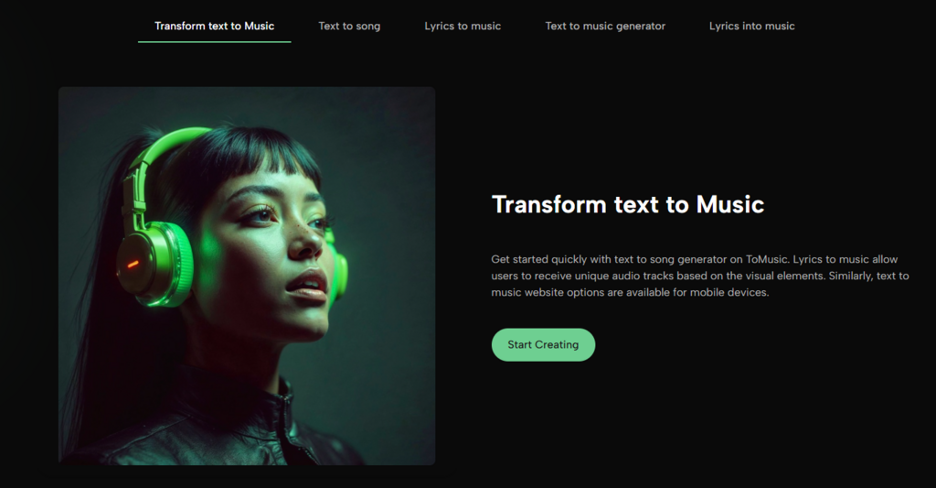
ToMusic earns its position at the top of the 2026 list due to its comprehensive approach to song construction. Unlike platforms that focus purely on the “vibe,” this system allows for a deeper level of input regarding structure and instrumentation. Whether you are starting with a simple mood description or a fully realized set of verses, the output maintains a high level of harmonic coherence. In my testing, the ability to switch between model versions (V1-V4) is a significant advantage, as it allows users to choose between a fast “sketch” and a deeply layered “master” track.
Minimax and Mureka: Rising Competitors in Global Soundscapes
Two notable entries that have gained massive traction recently are Minimax and Mureka. Minimax is celebrated for its incredible style adherence, often capturing the specific “grit” of niche genres that other models miss. Mureka has focused on a beginner-friendly interface that mimics the social experience of sharing music, making it highly accessible for those who are just starting their AI journey. Both platforms offer generous free tiers, though they sometimes lack the advanced “stem separation” features found in more production-oriented tools.
Suno: The Industry Standard for Immediate Melodic Catchiness
Suno remains a powerhouse in 2026, particularly for creators who need high-impact results with minimal effort. Its strength lies in its “Studio” editor, which has evolved into a robust tool for minor post-generation tweaks. While it is excellent for generating a viral-ready chorus, some professional users find its default “sheen” a bit too processed for acoustic or indie projects. However, for most content creators, its ability to produce a full song in under 60 seconds remains a benchmark for the industry.
Bridging the Gap Between Written Lyrical Concepts and Final Audio
Mastering the Transition From Initial Lyrics to Song Output
The most difficult part of traditional songwriting is often the arrangement—deciding how a verse should feel compared to a chorus. A high-quality Lyrics to Song workflow removes this hurdle by suggesting arrangements based on the emotional tone of the words. In 2026, these engines have become adept at recognizing “tension and release,” building energy leading into a chorus and stripping back instruments for a bridge. In my experience, using more descriptive language within the lyrics—such as stage directions like [Upbeat Chorus] or [Soft Piano Outro]—can dramatically improve the structural accuracy of the generated piece.
Addressing Technical Limitations and Enhancing Credibility
While the technology is transformative, it is not without its quirks. AI can occasionally struggle with complex rhyme schemes or metaphors that are too abstract. There is also the “prompt dependency” factor: a poorly written prompt will almost always yield a generic result. To achieve a truly unique sound, creators should expect to spend time refining their inputs. It is often better to generate three or four versions of the same idea and then use the platform’s editing tools to combine the best elements of each, ensuring the final track truly reflects the original vision.
Feature Comparison of Leading AI Music Platforms in 2026
| Evaluation Criteria | ToMusic.ai | Suno Studio | Mureka | Soundraw |
| Primary Workflow | Text & Lyrics | Prompt-driven | Social/Prompt | Custom Modular |
| Vocal Realism | Exceptional | Very High | High | N/A (Instrumental) |
| User Control | High (Multi-model) | Moderate | Basic | Very High |
| Processing Speed | Fast | Instant | Fast | Immediate |
| Commercial Use | Standard License | Paid License Only | Tiered License | Full Royalty-Free |
The Strategic Importance of High Fidelity Audio in Modern Content
Building Brand Authority Through Original Soundscapes
In an era where stock music has become repetitive and overused, AI offers a way for brands to develop a unique “sonic logo.” By generating original music for every video, creators can ensure that their content feels fresh and consistent. This level of customization was once only available to brands with massive budgets, but in 2026, it is accessible to anyone with a subscription and a clear creative direction. Original music not only avoids copyright strikes but also builds a deeper emotional connection with the audience.
The Evolution of the Creator Economy Toward AI Collaboration
The role of the “creator” is evolving into that of a “director.” Instead of playing every instrument, the modern musician directs the AI to perform according to their vision. This collaboration does not replace the need for musical taste; if anything, it makes “taste” more important than ever. As we look toward the future, the platforms that succeed will be the ones that empower the human to remain the ultimate arbiter of quality, providing the tools to realize complex ideas faster and more effectively than ever before.