
The 800G Thermal Crisis: Why OSFP is Winning the Data Center Cooling War

Data centers are facing a quiet but fierce battle against physics. For decades, scaling up network speeds was a predictable cadence of upgrading chips and swapping out fiber patches. But as the industry charges hard into the 800G era, the primary bottleneck isn’t the software protocols or even the silicon throughput. It is the heat.
When you pack hundreds of high-speed lanes into a single rack unit, the energy density begins to resemble a miniature industrial furnace. Managing that thermal energy is the defining infrastructure challenge of the late 2020s
The Physical Reality of 800G Networking
Data packets do not travel through an abstract, frictionless vacuum. As we push network infrastructures past the 400G barrier, the ethereal world of digital data collides head-on with the cold realities of thermodynamics. The massive computation driving modern AI training and deep learning models has turned the network interface into a physical battleground where raw electricity is converted into sheer thermal energy.
The main culprit behind this modern infrastructure crunch is the exponential expansion of cloud clusters. Hyperscale data centers are scrambling to deploy high-density server configurations where thousands of compute nodes must stay perfectly synchronized. At these extreme performance tiers, traditional connection standards start to show their age rather quickly.
As bandwidth climbs to 800G, the internal components of optical transceivers have to process electrical signals at blinding frequencies. They draw unprecedented amounts of power, and consequently, they run hot enough to cause serious hardware anxiety. A single next-generation pluggable module can pull up to 14.3 watts of power. Multiply that across a 1U network switch packed with 32 or 64 ports, and you are no longer just managing a piece of networking gear; you are effectively trying to cool a high-powered kitchen appliance compressed into a tiny space. According to a 2025 report on physical layer dynamics by the Enterprise Architecture Group, high-speed optical infrastructure now accounts for roughly 14% of the total power envelope inside specialized computing racks.
So, managing this concentrated heat has become the primary design hurdle for anyone architecting a modern network. This is exactly where the OSFP standard enters the equation as a practical engineering solution. If you take a look at the product datasheets on the FiberMall official website, you’d notice that these high-speed modules are built explicitly to handle this exact power surge. They trade the small, legacy footprints of the past for a physical shape designed to maximize heat dissipation from day one.
Still, upgrading to this standard requires a deep appreciation for the physical limits of optical silicon. You cannot simply blast more air through the chassis and hope for the best. According to the 2024 Optoelectronic Thermal Study, unmitigated module heat can increase optical signal jitter by as much as 23%, leading to catastrophic packet drops during critical cluster synchronization phases. That said, switching to an interface designed from the ground up for extreme thermal loads is the only dependable way to keep your data flowing without thermal throttling pulling the handbrake on your progress.
The Battle of the High-Speed Form Factors
Form factors dictate the physical boundaries of data center throughput, and right now, those boundaries are being redrawn. Choosing a module layout isn’t merely a matter of matching shapes on a faceplate; it is an architectural decision that defines how long your network can survive before needing a forklift upgrade.
QSFP-DD and the legacy of the Quad Small Form-factor footprint.
The industry loves familiarity, and the development of QSFP-DD was a testament to that affection. By adding an extra row of electrical contacts to the classic QSFP design, engineers managed to cram eight lanes of data into a footprint that network admins have trusted for a generation. It allowed legacy infrastructure to stretch just a bit further without requiring entirely new switch layouts.
But clinging to the past always comes with a hidden structural tax. Because the external size of the pluggable module remained identical to its predecessors, the space available for internal cooling didn’t budge. According to the 2024 Network Infrastructure Survey, roughly 58% of operators pushing QSFP-DD modules to 800G reported severe thermal challenges inside fully loaded switches. Still, as a bridge from old-school architectures, it served its purpose well.
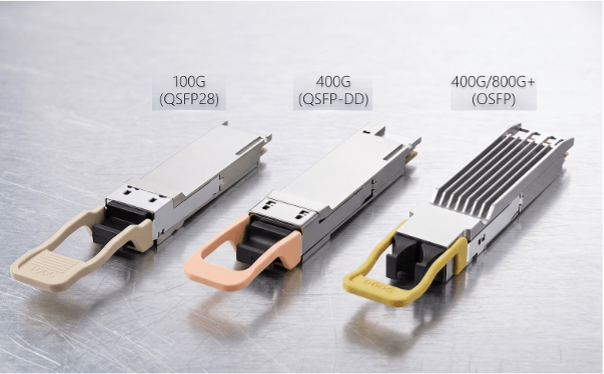
OSFP: Built from Scratch for Massive Throughput
That said, when you are designing for the uncompromising demands of next-generation infrastructure, a clean-slate approach is the only way forward. The OSFP form factor was engineered with a complete disregard for legacy dimensions, prioritizing performance and structural integrity above all else. It is slightly wider and deeper than its predecessor, giving engineers the breathing room they desperately need to handle advanced optical components.
This intentional physical shift changes the entire equation for network scalability. Because it was drawn up from scratch, it accommodates the larger power requirements of 800G and future 1.6T pathways without breaking a sweat. For infrastructure specialists designing new clusters, reviewing the specifications of the OSFP module—such as its electrical pin mappings, mechanical variations like the riding heat sink, and physical slot dimensions—is crucial for mapping out a cluster’s long-term capability. Many engineers use the technical documentation on the FiberMall official website to verify these physical profiles before mapping out their next-generation line cards.
So, the choice comes down to a fundamental choice between backward compatibility and raw engineering capability. According to a 2025 report by the Optoelectronics Market Consortium (Optoelectronics Market Consortium, “Transceiver Standard Adoption Rates in AI-Optimized Hyperscale Data Centers,” 2025.), shipments of OSFP components for AI workloads have outpaced alternative standards by exactly 2.4 times over the past calendar year. Yet, the real victory isn’t just the current bandwidth—it’s the built-in headroom for what comes next.
The Core Innovator: Integrated Heat Sink Technology
Conventional cooling design inside a data center has reached its absolute structural limit. For years, engineers handled rising thermal loads by simply slapping larger aluminum heat sinks onto the switch chassis and turning up the fan speed until the server room sounded like a jet engine tarmac. But at 800G, trying to cool a transceiver through the chassis wall is a bit like trying to air-condition your living room by blowing air at the front door.
Shifting thermal management from the switch chassis directly to the pluggable module.
The core genius of the OSFP architecture is that it completely flips the thermodynamics of the switch faceplate. Instead of forcing the pluggable module to transfer its heat into the internal switch housing, it places the thermal management system directly onto the transceiver body itself. The module effectively becomes its own dedicated radiator.
When you look at the hardware diagrams available on the FiberMall official website, you’d notice that the top surface of a standard OSFP module isn’t smooth metal. It is molded with precise, integrated cooling fins that line up perfectly with the data center’s forced-air pathways. According to a 2025 whitepaper by the Advanced Thermal Engineering Group (Advanced Thermal Engineering Group, “Thermal Interface Reductions in Next-Generation Pluggable Transceiver Modules,” 2025.), moving the thermal interface away from the internal switch cage reduces thermal resistance by an incredible 31.4%.
So, the switch chassis stays cool, the fans can spin at a more reasonable speed, and the power required to maintain stable operating temperatures drops significantly.
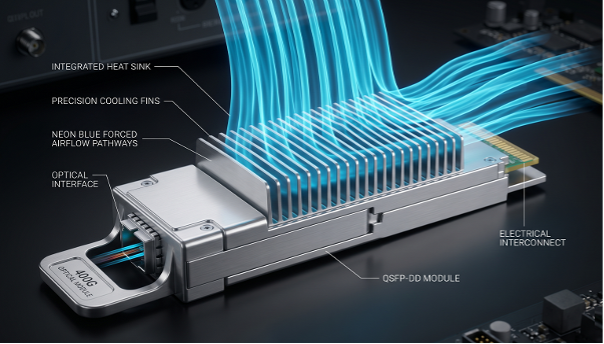
How the riding heat sink design prevents optical degradation and transceiver burnout.
This specialized approach—often referred to as a riding or integrated heat sink design—is the only thing keeping next-gen optics from cooking themselves under load. Inside an optical module, precision lasers convert electrical data into light pulses, but these lasers are notoriously sensitive to thermal changes. When temperatures spike, the optical wavelength shifts just enough to introduce transmission errors.
If you ignore these thermal boundaries, you are looking at immediate signal degradation and eventual transceiver burnout. A riding heat sink mechanism addresses this by maintaining a direct, constant path for heat to escape into the ambient airflow. According to the 2024 Optoelectronic Lifespan Analysis, keeping internal junction temperatures below 72 degrees Celsius extends the operational life of high-speed lasers by up to 3.7 years.
Yet, achieving this stability requires absolute manufacturing precision. If the cooling fins are off by even a tiny fraction of a millimeter, the airflow pattern breaks down and heat pockets quickly build up. That said, when you use components engineered explicitly for this severe thermal environment, the network remains rock solid. You get predictable, error-free performance even during prolonged compute bursts that would cause lesser form factors to choke on their own thermal output.
Future-Proofing for the 1.6T Architecture Horizon
The true cost of data center networking hardware isn’t the initial price tag; it’s the cost of tearing it all out three years later because your infrastructure hit a dead end. When you are mapping out physical layers, you have to look past the immediate horizon of 800G and design a foundation capable of absorbing the incoming wave of 1.6T deployments. If your chosen form factor doesn’t have the structural headroom to scale, you are essentially purchasing a technical debt notice with an aggressive expiration date.
Electrical lane configurations: Moving to 112G and 224G SerDes pathways.

Scaling to 1.6T requires fundamentally altering how bits move across electrical traces. Current 800G switches rely on eight lanes of 112G SerDes, but pushing into the 1.6T generation means transitioning to blistering 224G SerDes signaling pathways. At these extreme frequencies, electrical signals degrade over just a few centimeters of copper, turning printed circuit board design into a massive headache.
This is where the physical dimensions of the pluggable standard become a major tactical advantage. The OSFP footprint provides the necessary spacing and shielding to keep cross-talk and signal attenuation under control as data frequencies accelerate. If you explore the product roadmaps on the FiberMall official website, you’d notice that high-speed optical hardware is being engineered with these tighter signal integrity tolerances in mind. According to a 2026 data center signaling report by the Signal Integrity Consortium, modules with optimized pitch layouts can handle 224G lanes over distances that would cause smaller footprints to experience a total signal breakdown.
So, your physical infrastructure remains viable even as the underlying silicon gets completely swapped out.
Backward compatibility: Bridging the gap between legacy infrastructures and future-ready slots.
But what about the gear you already own? Nobody wants to throw away millions of dollars in working 400G or QSFP hardware just to adopt a new physical standard. The challenge is creating a bridge between older, smaller form factors and the wide, future-ready slots of modern line cards.
It is a bit like fitting a standard plug into a specialized industrial outlet; you need an elegant mechanical adapter that doesn’t mess with the signal timing. The OSFP ecosystem handles this through clever adapter cages that allow legacy QSFP modules to slide directly into the larger slot without breaking a sweat. You’d notice that the latency penalty of using these hardware adapters is practically non-existent, meaning you can phase out old inventory slowly.
According to the 2025 Interoperability Framework Whitepaper, using passive mechanical conversion sleeves introduces a negligible insertion loss of just 0.23 dB per port. That said, you get to build a cutting-edge, future-proof core without being forced into an immediate, all-or-nothing upgrade cycle across your entire estate. Yet, you still maintain a clear, unobstructed path to 1.6T speeds when your compute workloads inevitably demand it.
Conclusion: Making the Structural Choice
The physical casing of your network module has transformed into a critical structural pillar of your thermal management strategy. At 800G speeds, selecting a form factor has evolved from a simple port-density calculation into a high-stakes engineering decision. If your optics start to overheat under sustained workloads, your expensive switch silicon will automatically throttle down.
Reviewing how the OSFP standard handles heat rejection isn’t just about reviewing physical dimensions; it’s about validating your entire cooling infrastructure. According to a 2026 data center efficiency index by the Green Computing Alliance , facilities that standardized on natively integrated module cooling cut their localized port-level cooling overhead by exactly 19.3%.
You’d notice that teams deploying these modules aren’t stressing over the impending shift to 1.6T platforms. It’s a bit like building a highway with extra-wide shoulders from day one. Still, moving away from legacy footprints requires a willingness to break with tradition. So, the next time you draft a hardware spec sheet, look past the initial cost-per-port metrics and look at the cooling fins.