
Jitterbit API Manager: A Complete Guide to Modern API Management for Enterprise
APIs are no longer a back-end technical detail that only developers need to think about. They have become one of the most critical pieces of infrastructure in modern business, sitting at the center of how organizations connect applications, share data, automate workflows, and deliver experiences to customers and partners. For enterprises, the ability to create, publish, secure, and monitor APIs at scale is not optional. It is foundational.

The challenge is that managing APIs across a large organization is genuinely complex. Without a centralized system, APIs multiply across teams and environments without consistent governance, security becomes fragmented, and the visibility needed to diagnose problems or track usage simply does not exist. That is the problem an enterprise api management platform is designed to solve, and it is the core purpose behind Jitterbit API Manager.
What API Management Actually Means
Before getting into how Jitterbit approaches the problem, it helps to understand what API management (APIM) actually involves. At its core, APIM is the process of creating, publishing, controlling, and analyzing APIs in a secure and scalable environment. It provides a unified platform to scale, share, and govern APIs while ensuring security and access control. It also provides usage analytics for reporting and performance improvement.
An API management platform is the software tool that makes all of this possible. It handles the full lifecycle of an API, from the initial design and deployment through ongoing monitoring, security enforcement, and eventual retirement. The key components of any capable platform include API design and publishing tools, an API gateway that sits between clients and backend services to manage routing and delivery, a developer portal where APIs can be discovered and consumed, security controls covering authentication and access, and analytics that give teams visibility into how APIs are performing and being used.
The reason businesses increasingly need this kind of platform is straightforward. Organizations now depend on APIs for nearly everything, from launching new products and integrating partner systems to automating internal workflows and delivering customer-facing features. Without effective management in place, those dependencies become liabilities rather than assets.
How Jitterbit API Manager Works
Jitterbit API Manager is built around the idea that creating, controlling, consuming, and monitoring APIs should happen in one place, with a simple and intuitive interface that does not require specialized expertise to use effectively.
On the creation side, the platform allows teams to create and publish integrations and workflows as APIs with just a few clicks. External APIs can be exposed as proxies for centralized management through the Jitterbit Harmony platform. APIs support both standard HTTP methods and custom-defined methods, making the platform flexible enough to handle a wide range of use cases. APIs can be migrated across different environments with minimal friction, and capabilities can be extended through multiple paths and services as requirements grow.
For consumption, Jitterbit makes it easy for both internal and external developer communities to access and use published APIs. Organizations can provide customized API branding including logos, names, and contact information, and can productize APIs with terms and conditions for use. This developer-friendly approach matters because the value of an API depends not just on whether it works technically but on whether the people who need it can actually find it, understand it, and use it without requiring extensive hand-holding from the team that built it.
Security and Control Built Into the Platform
One of the areas where API management platforms most commonly fall short is security. Bolted-on security is not the same as security that is designed into the platform from the beginning, and for enterprises dealing with sensitive data and complex compliance requirements, the difference is material.
Jitterbit API Manager handles security through multiple authentication methods, including Basic Auth, API Keys, and OAuth 2.0. Trusted IP ranges and domain restrictions add layer of access control. API-level rate limiting prevents resource overloads and mitigates security threats, and private API gateways can be deployed to optimize traffic control for organizations with more demanding security requirements.
These controls are not add-ons or premium tiers. They are part of the core platform, which means every API published through Jitterbit can be governed consistently without requiring teams to piece together security tooling from separate products.
Monitoring and Analytics That Give Teams Real Visibility
Publishing an API and walking away is not a strategy. APIs degrade, get misused, hit performance bottlenecks, and generate errors that need to be caught and diagnosed quickly. Jitterbit’s monitoring and analytics capabilities are built to give teams the visibility they need to stay on top of all of it.
The platform provides a visual dashboard for monitoring API performance and consumption trends. Teams can access detailed consumption data filtered by API names and URLs, time periods, call status, and more. Response times, IP addresses, and HTTP response codes can all be analyzed for deeper insights into usage patterns. For debugging and troubleshooting, advanced operational and debug logs provide detailed API call tracing that makes it significantly easier to identify and resolve issues before they compound.
This level of monitoring is particularly valuable in enterprise environments where APIs are being consumed by multiple teams, third-party partners, or external customers simultaneously. Understanding exactly how APIs are being used and where performance problems originate is not a nice-to-have. It is what makes it possible to maintain reliability at scale.
AI-Powered API Creation and Management
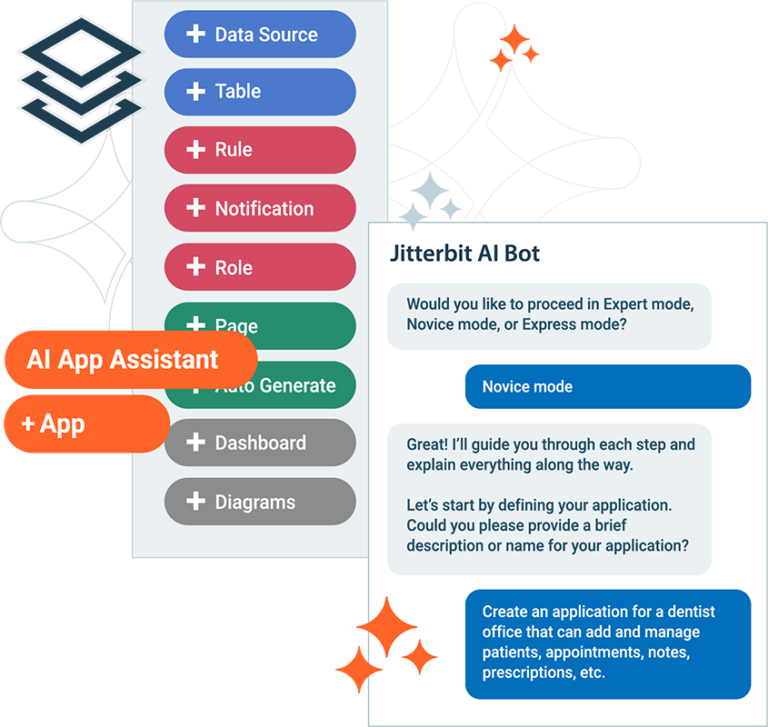
One of the capabilities that distinguishes Jitterbit’s approach from more traditional API management tools is the integration of generative AI directly into the API management workflow. The Jitterbit API Manager AI Assistant allows users to build and publish APIs using natural language commands, which reduces both the technical barrier and the time required to get new APIs into production.
This matters particularly for organizations that want to move faster without proportionally increasing the size of their development teams. When API creation and publishing can be driven through an AI-powered assistant rather than requiring deep technical expertise at every step, more people across the organization can participate in the process and iteration cycles shorten considerably.
The AI integration is not a standalone feature either. It sits within the broader Jitterbit Harmony platform, which means it connects directly to the same iPaaS integrations, App Builder applications, and EDI workflows that the rest of the platform supports.
The Unified Platform Advantage
One of the most important things to understand about Jitterbit API Manager is that it is not a standalone product. It is one component of the Jitterbit Harmony platform, which brings together iPaaS, API management, App Builder, and EDI integration in a single unified environment.
For enterprises, this matters a great deal in practice. When API management, integration, and application development are handled by separate tools from separate vendors, the overhead of connecting and maintaining those tools becomes a significant burden. Data does not flow cleanly between systems, context gets lost when moving between platforms, and the total cost of ownership climbs well beyond what any single tool’s licensing fee suggests.
Within Harmony, APIs created through the API Manager can be used immediately in applications built with Jitterbit App Builder, or incorporated into integration workflows running on the iPaaS platform. iPaaS integrations can be quickly transformed into reusable APIs that drive real-time workflow automation across the enterprise. This kind of tight integration between API management and the broader platform is what makes Jitterbit a genuine enterprise api management platform rather than just another API gateway.
What Real Customers Are Saying
The platform’s value is reflected in the feedback from organizations already using it. One customer on G2 described their experience this way: “We have been in collaboration for about a year now and not only is the product they offer amazing, but the service and well knowledgeable staffing has made our automation journey seamless and stress free.” Another noted, “We have found Jitterbit to be a very rich and full-featured integration platform. While our requirements and workflows are complex and demanding, Jitterbit has always afforded us a clean solution.”
Those perspectives reflect something important about what API management actually requires in practice: technical capability is table stakes, but the combination of a genuinely useful product and responsive support is what determines whether an enterprise automation and integration journey is smooth or frustrating.
Who Jitterbit API Manager Is Built For
Jitterbit API Manager is designed for organizations that need to manage APIs seriously at scale. That means enterprises dealing with complex integrations across multiple systems, teams, and environments. It means organizations in regulated industries where consistent security and access control governance is not optional. It means development teams that want to move faster without sacrificing the control and visibility that enterprise operations demand.
The platform is equally useful for organizations that are just beginning to formalize their API strategy and want to build on a foundation that will scale with them, and for organizations that already have mature API programs and need better tooling to manage growing complexity. Because it sits within the broader Harmony platform rather than operating in isolation, it is particularly well-suited to enterprises that are also managing integration and application development challenges alongside their API management needs.
For any organization where APIs are a meaningful part of how the business operates, getting API management right is not a project to defer. The cost of fragmented, unmanaged APIs compounds over time as systems multiply and dependencies deepen. A platform that handles the full lifecycle in one place, with AI assistance, enterprise-grade security, and deep integration with the broader technology stack, represents a significantly better foundation than assembling that capability from disconnected tools.